
Ground Penetrating Radar Surveys in Derby
Enquire Today For A Free No Obligation Quote
At Ground Penetrating Radar Surveys in Derby, we specialise in a non-invasive method of investigating subsurface conditions using high-frequency electromagnetic waves.
Ground penetrating radar (GPR) works by transmitting radar pulses into the ground and analysing the reflected signals to detect variations in material density, structure, or embedded objects.
Since traditional excavation and trial pits are time-consuming, expensive, and potentially hazardous, GPR survey in Derby provides a rapid, safe, and accurate way to explore underground features with minimal disruption.
As construction, infrastructure, and utility projects demand greater clarity of what lies beneath, GPR has become a preferred tool for early-stage planning, risk management, and compliance.
Request a free quote from Ground Penetrating Radar Surveys in Derby today.
What Is a Ground Penetrating Radar Survey in Derby?
A ground penetrating radar survey in Derby uses radar technology to produce images or data about underground features such as buried utilities, voids, foundations, reinforced structures, or geological layers.
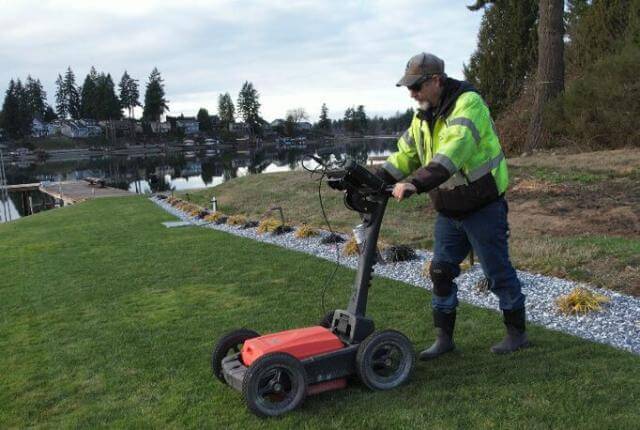
Surveyors operate GPR equipment by moving an antenna across the surface, which emits radar signals into the ground and captures reflections caused by material boundaries or embedded items.
Since the return time and strength of the signal depend on the depth and composition of materials in Derby, survey data can be interpreted to map features that are invisible to the naked eye.
What Can GPR Detect in Derby?
Ground Penetrating Radar (GPR) in [ocation] is used to detect a wide range of underground utilities, structures, and subsurface features without excavation.
It can locate water pipes, gas pipelines, electrical cables, fibre optic lines, and drainage systems hidden below ground.
GPR is also used to map concrete reinforcement, rebar, post-tension cables, voids, cracks, and changes in slab or wall thickness, which makes it essential for structural and engineering surveys in Derby.
Beyond construction, GPR can identify soil layers, buried foundations, tunnels, archaeological remains, and even groundwater levels.
The investigation survey makes GPR a versatile tool for construction projects, utility mapping, civil engineering, environmental studies, and heritage investigations in Derby.
What Is the Maximum Depth of GPR?
The effective depth range of a GPR survey in Derby depends on the frequency of the antenna and the conductivity of the ground.
Lower frequency antennas (e.g. 250 MHz) can reach depths of up to 4 metres, while higher frequency antennas (e.g. 900 MHz) are suitable for shallow, high-resolution scanning up to 1 metre deep.
Since wet or clay-rich soils reduce penetration depth, site conditions in Derby are assessed in advance to select the most suitable equipment.
Is Ground Penetrating Radar Safe in Derby?
Ground penetrating radar is a non-destructive and safe technology, emitting low-powered radio waves that do not harm people, animals, or infrastructure.
As no drilling, digging, or invasive work is required, GPR surveys in Derby are suitable for use in live environments such as schools, hospitals, data centres, and operational construction sites.
Surveyors in Derby follow industry best practices and comply with UK safety regulations when working near utilities or sensitive infrastructure.
How Much Does a Ground Penetrating Radar Survey Cost in Derby?
The cost of a ground-penetrating radar survey in Derby starts from £500 to £900 for small-scale or single-area scans.
Larger or more complex surveys involving multiple areas, deep scanning, or CAD/GIS reporting may range from £1,000 to £3,000+, depending on scope and site conditions.
Quotes in Derby are calculated based on area size in square metres, required scan depth and resolution, number of features to locate or verify and reporting format (e.g. site mark-up, CAD drawing, 3D model).
Who Uses GPR Surveys in Derby?
GPR surveys in Derby are used by construction companies, engineers, and contractors to detect underground utilities and structures before excavation.
Utility providers use GPR surveys in Derby to map buried pipes, cables, and drainage networks.
Archaeologists and heritage specialists use GPR surveys in Derby to locate historical remains without disturbing the ground.
Environmental consultants and geotechnical engineers use GPR surveys in Derby to assess soil conditions, voids, and groundwater.
Local authorities and developers also use GPR surveys in Derby to support safe planning, design, and infrastructure projects.
What Are the Benefits of Ground Penetrating Radar Surveys in Derby?
GPR surveys in Derby deliver fast, reliable insights into subsurface conditions without disrupting the ground or surrounding infrastructure.
The key benefits include:
- Provides non-invasive, real-time imaging of underground features
- Detects metallic and non-metallic objects, including voids and reinforced elements
- Reduces risk of costly errors during excavation or drilling
- Supports safe working practices by identifying unknown services or hazards
- Allows surveys in sensitive or live environments with minimal disruption
- Produces accurate data for CAD, GIS, or BIM integration
- Accelerates project timelines by removing guesswork from the site investigation process
As underground uncertainty remains a leading cause of delays and cost overruns, GPR helps improve confidence in design, safety, and asset management.
Can GPR Be Used Indoors or on Concrete Slabs in Derby?
Ground penetrating radar can be used indoors and over reinforced concrete slabs, making it ideal for scanning factory floors, basements, or suspended slabs in Derby before drilling or cutting.
As GPR can detect rebar, post-tension cables, conduits, and voids within concrete, it is frequently used for slab assessment in Derby prior to core drilling, saw cutting, or mechanical installations.
Can a GPR in Derby Replace a Full Utility Survey?
A GPR survey in Derby is a valuable tool but is usually used in combination with electromagnetic location (EML) as part of a full PAS 128 utility survey.
Since no single detection method can locate all services with equal accuracy, combining GPR with EML improves confidence levels and helps meet PAS 128 quality standards.
For targeted investigations, GPR can be deployed on its own where specific non-metallic features need to be located in Derby.
How Quickly Can a GPR Survey in Derby Be Carried Out?
Most ground penetrating radar surveys in Derby can be scheduled within 48 to 72 hours, with site work typically completed within 1–2 days, depending on area and complexity.
Reporting and drawing production in Derby can follow within 2 to 5 working days, with faster turnaround available upon request.
Can GPR Detect Plastic or Clay Pipes in Derby?
A ground-penetrating radar survey in Derby can detect plastic or clay pipes, although results depend on the pipe size, depth, and surrounding soil conditions.
Since GPR works by identifying contrasts in material density and dielectric properties, plastic and clay may produce weaker reflections than metallic objects.
As a result, survey success in Derby is influenced by operator experience, equipment frequency, and the presence of surrounding features that help distinguish the pipe’s location.
Is GPR Affected by Soil Type in Derby?
The effectiveness of a ground penetrating radar survey in Derby is strongly influenced by soil type.
As clay-rich or highly conductive soils absorb radar signals, they reduce the depth and clarity of scan data.
In contrast, dry, sandy, or granular soils allow deeper signal penetration and more reliable target identification.
Since conditions vary across Derby and in the UK, site-specific assessments are carried out to determine whether GPR is suitable for your location.
Can You Use GPR in Wet or Flooded Areas?
GPR can be used in damp or recently rained-on areas, but its performance may be reduced in fully saturated or flooded ground.
Since water increases the conductivity of soil, radar signals may be absorbed or distorted before reaching deeper layers.
Where possible, ground penetrating radar surveys in Derby are scheduled during drier periods, or alternative methods are considered for waterlogged conditions.
Do You Need to Prepare the Ground Before a GPR Survey in Derby?
Minimal preparation is required for most GPR surveys in Derby, although the surface should be relatively flat and free from excessive obstructions such as rubble, plant equipment, or standing water.
As GPR antennas need direct contact with the ground, a clean scanning path improves data resolution and coverage.
In overgrown or rough areas in Derby, a light clearance may be recommended before the survey takes place.
Can GPR Be Used to Detect Sinkholes or Voids in Derby?
A ground penetrating radar survey in Derby can be used to identify underground voids, sinkholes, or areas of subsurface settlement.
As radar signals reflect off air-filled spaces or loose material, anomalies in the radargram can indicate potential structural weaknesses or ground instability.
Since void detection requires interpretation of subtle signal changes, the survey must be carried out in Derby by an experienced GPR technician to confirm accuracy.
Can You Scan Through Tarmac or Concrete in Derby?
Ground penetrating radar in Derby is commonly used to scan through tarmac, concrete, and paved surfaces, particularly when locating utilities or assessing slab conditions.
As radar can penetrate these materials effectively, especially when dry, GPR is well-suited to highways, car parks, warehouse floors, and other hardstanding areas.
The scan depth will vary in Derby based on thickness and material type but is typically sufficient for most construction and utility needs.
Is a Permit Required for a GPR Survey in Derby?
A GPR survey in Derby does not usually require a permit when conducted on private land, construction sites, or controlled areas.
As public highways or footpaths are often governed by local council regulations, access or traffic management plans may be needed if scanning occurs in these areas.
Permit requirements in Derby are reviewed during the project scoping phase to ensure compliance with all local and statutory rules.
How Accurate Is Ground Penetrating Radar in Derby?
The positional accuracy of a ground penetrating radar survey in Derby typically falls within ±50 mm for shallow targets and ±100 mm for deeper detections, depending on soil conditions and antenna frequency.
As GPR provides depth and location data in real time, accuracy also depends on correct calibration, survey line spacing, and interpretation methodology.
Where higher positional certainty is required, GPR results in Derby can be correlated with GPS data or combined with electromagnetic methods.
Can GPR Be Used for Archaeological Investigations in Derby?
GPR is widely used in archaeology to detect buried walls, floors, graves, ditches, and other historical features.
As it provides non-destructive imaging of subsurface layers, a ground penetrating radar survey in Derby can support heritage assessments and excavation planning without disturbing the site.
Results are typically reviewed by specialists in Derby who interpret the data in the context of expected features and historical records.
What Is a Radargram in Derby?
A radargram is the visual output of a ground-penetrating radar survey, showing a two-dimensional cross-section of the subsurface along the survey line.
As radar waves encounter changes in material or embedded objects, reflections are displayed as curved or hyperbolic shapes in the radargram.
Interpreting radargrams correctly requires trained analysis to distinguish between utilities, voids, reinforcement, or natural ground features in Derby.
Get a Free Quote for Ground Penetrating Radar Assessments in Derby
A ground penetrating radar survey in Derby offers a fast, accurate, and non-destructive method of understanding what lies beneath your site.
Since underground uncertainty can delay projects, increase costs, and create safety risks, GPR surveys provide essential data for better decision-making in construction, design, and asset management.
Whether you need to locate rebar, avoid utility strikes, or verify ground conditions, we deliver high-quality GPR data tailored to your project goals.
Get a free quote from Ground Penetrating Radar Surveys in derbyshire today, and move forward with confidence beneath the surface.
Find More Info
Make sure you contact us today for a number of great ground penetrating radar survey services in East Midlands.
Here are some towns we cover near Derby DE1 3
Derbyshire, Belper, Ilkeston, Heanor, StaplefordFor more information on Ground Penetrating Radar Surveys in Derby DE1 3, fill in the contact form below to receive a free quote today.
★★★★★
We hired Ground Penetrating Radar Surveys before beginning excavation on a commercial site in Reading, and their service was outstanding. The team arrived promptly, worked efficiently, and identified several buried utilities that weren’t shown on any plans. Their detailed report saved us both time and costly rework — highly professional from start to finish.
Michael Redfern
Derbyshire
★★★★★
Ground Penetrating Radar Surveys carried out an assessment for our structural renovation, and the accuracy of their findings was excellent. They detected voids and rebar locations with precision, which gave us full confidence before drilling. The technicians were knowledgeable, courteous, and delivered results faster than expected.
Emma Calder
Derbyshire